COLDWATER LAKE ASSOCIATION
  • Home
  • Association Info
    • Golf Cart Ordinance
    • Become a Member/Renew
    • Programming
    • Building Rental
    • Board Members
    • Marine Patrol
    • Lake History
    • Memberships/Donations
    • Contact
    • Fire Department Donors
    • Newsletter
  • LAKE EVENTS
    • Lake Events/Activities
    • Boater Safety Classes
    • Fireworks
  • Water Quality
Picture
Water Quality Reports
Report Exotic Aquatic Weeds
Monitoring Program
Become a Volunteer
Report Suspicious Foam
Scroll Down to Read More
Report a Harmful Algae Bloom
Picture
Picture
Picture

​ RSVP to the November 18, 2025 | 7:00 PM Eastern Webinar to Receive the Link

​The “Keep Coldwater Clear” initiative aims to preserve the ecological, scenic, and recreational value of Coldwater Lake for current and future generations. Protecting the lake and its watershed depends on all residents—both along the shore and nearby—understanding water quality threats and taking action to reduce them. Through outreach and education, the Coldwater Lake Association helps residents learn how daily choices affect the lake’s health and what steps can prevent harm. Everyone is encouraged to get involved in local protection efforts and attend the informational Zoom meeting on Tuesday, November 18, 2025, at 7 p.m.

Please complete this RSVP to receive the link to the Webinar.  Together, we can Keep Coldwater Clear.
~ PLEASE RSVP TO RECEIVE THE LINK ~
Picture

"Keep Coldwater Clear" Water Quality and Sustainability Initiative

Picture
A Lake Environment Improvement Committee was commissioned by the Coldwater Lake Association on August 12, 2025 to protect Coldwater Lake’s water quality, aquatic ecosystems, and surrounding watershed by monitoring water quality parameters and educating and inspiring the community in ways that can help keep our lake healthy, natural and clear. Over the years, the lake has faced many threats to its beautiful, clear waters. While the lake has seen changes, our commitment to Keep Coldwater Clear has not. 

The Coldwater Lake Association supports Coldwater Lake as an all-sports lake with a strong water-sports tradition. While enjoying recreation, we must also be good stewards of the environment. Lakes naturally change over time, but human activity can accelerate unpleasant effects. By making small adjustments, we can reduce negative impacts and preserve the lake for the future. Many harmful habits are unintentional, and our goal is to share knowledge that helps you make informed choices. Just as we practice good neighborliness, we can practice friendly boating and environmental care, ensuring the lake remains a treasure for generations.
Please help us to protect Coldwater Lake now and for generations to come. Attend our informational meetings and browse our educational content so you too can affect positive change on the lake and along your own property's shoreline. Become a Coldwater Lake Association member, volunteer, shop our store (coming soon), donate.  Together, we can Keep Coldwater Clear.
Picture

Lake Dwellers Guide to Protecting Water Quality in Coldwater Lake

Picture

Autumn Leaves  “Don’t Rake into the Lake!”

Decomposing yard waste is a major source of excess nutrients that cause algal blooms, deplete dissolved oxygen, and harm aquatic life. Instead of raking into the lake, here are the general recommendations for managing fall leaves near a lake:
Picture
Why raking leaves into or near a lake is harmful
  • Nutrient overloading: Piling leaves on or near the shoreline increases the amount of phosphorus and other nutrients that wash into the lake during rain or snowmelt.
  • Algal blooms: Excess nutrients act as a fertilizer for nuisance weeds and algae, which can lead to unsightly, unhealthy, and sometimes toxic algal blooms.
  • Reduced oxygen: When the leaves decompose in the water, it uses up oxygen that fish and other aquatic animals need to survive, which can lead to fish kills
  • Habitat damage: Raking the lake bottom can stir up sediment and destroy the habitat of critters living in the lake bottom. 
What to do with leaves instead
  • Rake leaves away from the shore: Move any leaves that have fallen on streets, driveways, or lawns and are at risk of washing into the lake. Keep them out of the storm drain system and gutters.
  • Mulch the leaves: Use a mulching mower to shred the leaves and leave them on your lawn. The small pieces will filter down to the soil, providing free, natural fertilizer and enriching the soil.
  • Compost the leaves: Start a compost pile for your garden to turn the leaves into nutrient-rich compost for use next season or bring your yard waste to a compost site.
  • Create leaf piles: You can make designated piles in garden beds or beneath trees to help enrich the soil and create habitats for beneficial insects. 
Picture

What is Phosphorus?

Phosphorus is a natural element and an essential nutrient for plant growth but is found only in small amounts in lakes and streams. Excess phosphorus is not a friend to lakes.  Even small increases in phosphorus can lead to negative results such as stimulating algae growth and the unwanted green blooms as well as creating excessive plant growth in the lake. More phosphorus also leads to less fish as dying and decaying algae robs the water of dissolved oxygen fish require to thrive. 

Phosphorus can have a devastating impact on the water quality of our lake. Therefore, we need to be ever mindful of protecting the lake and keeping phosphorous levels as low as possible.

When it comes to fertilizing, ZERO is more!  
Phosphorus is not necessary for established lawns.  Most established lawns already have sufficient nutrients in the soil. Soil tests often reveal that extra nutrients are not needed.  
When homeowners apply only as much fertilizer as is necessary, nutrient runoff into surface or ground water is minimized and natural resources are protected.  The following laboratories perform soil testing.  You can also purchase DIY kits:

  • Michigan State University Extension
  • A&L Great Lakes Laboratories
  • Agri-Labs​
It is best not to use fertilizer at all. However, when necessary, there is a safer means to fertilize your lawn. When shopping for fertilizer, look for phosphorus-free fertilizer.  It's the law: Michigan Fertilizer Law (1994 PA 451, Part 85, Fertilizers) restricts the use of phosphorus fertilizers on residential and commercial lawns, including athletic fields and golf courses statewide. Both homeowners and commercial applicators must follow the phosphorus application restrictions.
Picture

Key Fertilizer Recommendations

  • Buy phosphorus-free: Look for a zero in the middle of the N-P-K nutrient analysis on the fertilizer bag, such as 20-0-10. The middle number represents the phosphorus content.
  • Choose slow-release nitrogen: Opt for fertilizers with at least 25% slow-release nitrogen. This allows your lawn to absorb nutrients over time, reducing the risk of runoff.
  • Use organic fertilizers: Organic fertilizers, like worm castings, release nutrients slowly and improve soil health without introducing harmful synthetic chemicals. They are less likely to contaminate groundwater.
  • Create a buffer zone: Do not apply any fertilizer within a 10 to 30-foot buffer zone adjacent to the lake or other waterways. Planting native, deep-rooted vegetation in this area will help filter runoff.
  • Mind your application: Use a drop spreader instead of a rotary spreader near the water to prevent granules from scattering directly into the lake. 
  • Clean up: Sweep up fertilizer released onto a hard surface, such as a sidewalk or driveway promptly.
  • Timing is key: Do not apply fertilizer before a heavy rainfall or on frozen ground, as this significantly increases runoff.
  • Don't use "weed-and-feed": These products contain unnecessary pesticides and are often applied where they aren't needed, causing further harm to the water.
Picture

​Keep Geese at Bay

If Canada geese frequent your lakefront, you likely have a lawn problem, not a goose problem. Large, manicured lawns near lakes attract more geese by creating a perfect habitat with easy access to food, water, and clear lines of sight to watch for predators. This leads to a higher population of resident geese, which can have significant negative environmental impacts. 

​
Why Geese Are Attracted to Lawns

Ideal food source: Geese are herbivores that prefer to graze on short, tender grass. Fertilizing and mowing a lawn produces highly nutritious grass blades that are a favorite food source for geese. An adult goose can eat up to four pounds of grass per day.

​
Safety from predators: Open, expansive lawns provide an unobstructed view of the surrounding area, which allows geese to spot and avoid predators easily.
Easy access to water: When a lawn extends directly to the lake's edge, it provides a seamless pathway for geese to move between grazing and water. The lake serves as a place to drink, bathe, and escape danger.
Reduced migration: With an abundance of food and safety, many Canada geese have become non-migratory, residing in one location year-round. This has increased Coldwater Lake’s resident geese population. 


Solution

Create a native buffer zone: Grow a shoreline buffer strip of tall native grasses, shrubs, or other plants at least 20 to 30 inches high. This creates a barrier that obstructs the geese's line of sight, making them feel vulnerable to predators.  

Limit fertilization and mowing: Reducing fertilizer use makes the grass less nutritious and attractive to geese. Allowing the lawn to grow taller than 6 inches also discourages grazing.

To properly and safely dispose of goose poop from a dock, scrape the waste into a garbage bag and use an environmentally friendly solution like vinegar to clean the area. Do not wash droppings directly into the water, as they contain harmful bacteria and nutrients that can contaminate the aquatic ecosystem. ​
Picture

Natural Shorelines

Are you considering shoreline improvements?  By using a softshore approach to landscaping your waterfront property, you can help preserve the very things that likely attracted you to lakefront living in the first place – clean water, abundant wildlife, good fishing and access to recreation.

Read More 
Picture

​2024 Water Quality Report

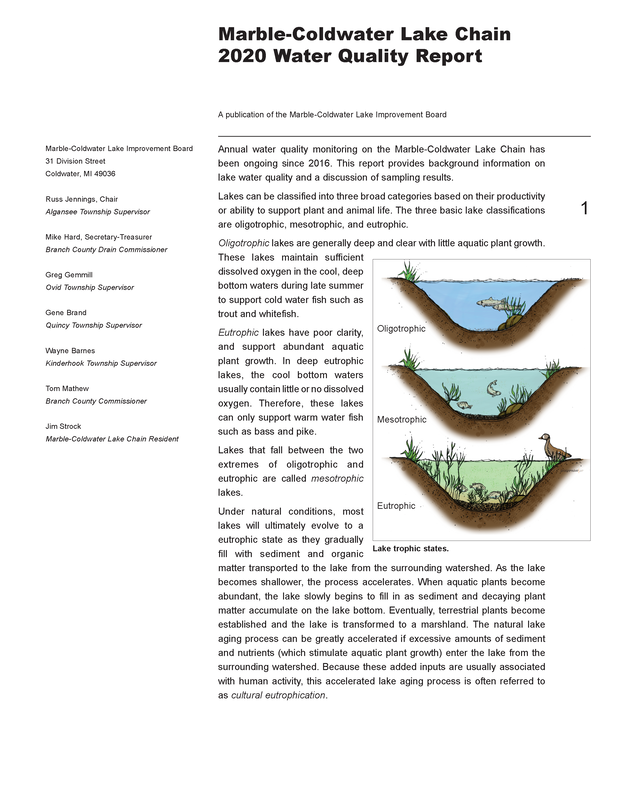
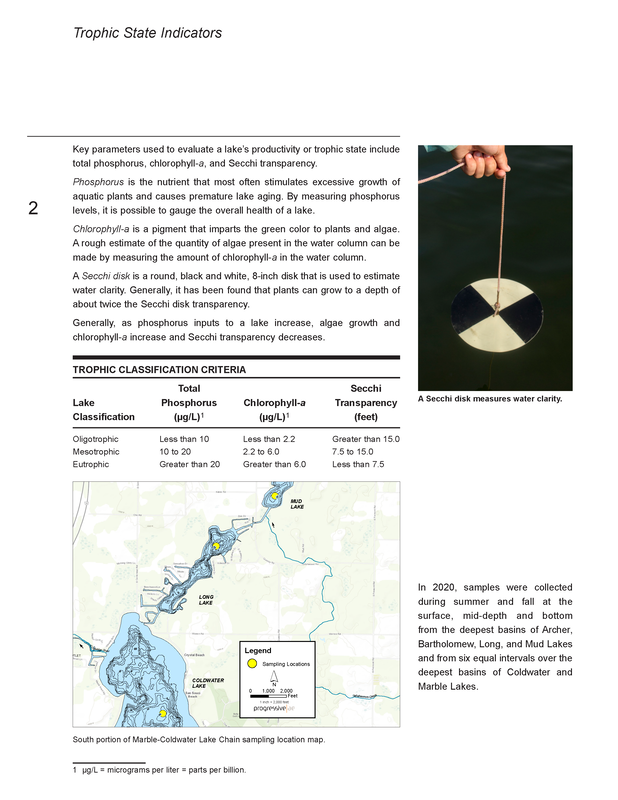
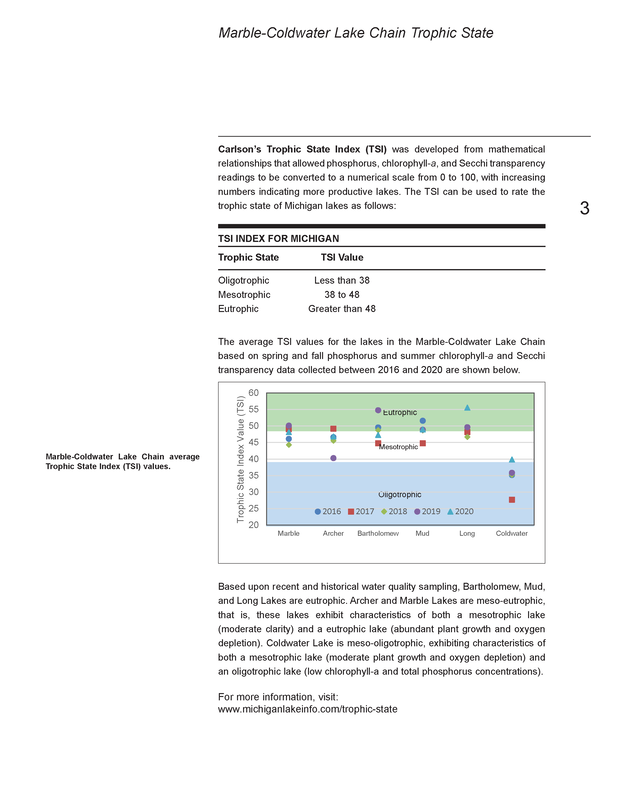
Per the 2024 Water Quality Summary Report produced by Progressive Companies AE for the Marble-Coldwater Chain Board, Coldwater Lake, historically an oligotrophic lake, now registers as mesotrophic.  In an oligotrophic lake  there are few plants and high water clarity, while a mesotrophic lake has moderate plant and algae growth, with more accumulated sediment and slightly lower water clarity. This progression is a natural part of a lake's life cycle, but human activities can accelerate it, leading to undesirable conditions.   Read the 2024 Water Quality Summary here.
Picture

​
Past Reports

​2024 Water Quality Summary
2023 Water Quality Summary
2022 Water Quality Summary
2021 Water Quality Summary
2020 Water Quality Summary
2019 Water Quality Summary
2018 Water Quality Summary
2017 Water Quality Summary
2016 Water Quality Summary
Picture

​Protecting Your Coldwater Lake Property Values


Healthy watersheds make healthy lakes and higher property values.

The clarity and quality of our lake is ultimately a reflection of how we take care of our own  land.  Waterfront property owners and inland neighbors, play a positive role in maintaining and improving the water quality of Coldwater Lake.

A nationwide meta analysis found that when all other factors were equal, properties on lakes with clearer water commanded significantly higher property prices. The Lake Environment Improvement Committee is exploring our water quality issues and examining opportunities to protect your property investment.  What you and your neighbors do also sustain or improve water quality and can improve resale potential. 

​On the other hand, if water quality is degraded, lower property values could result.  


Please help us to protect Coldwater Lake now and for generations to come by being part of the solution: Attend our informational ON-LINE meeting on November 18, 2025. ​
Picture
If your membership has lapsed or you have not already joined, become a member of the Coldwater Lake Association, volunteer.  Together, we can keep Coldwater Lake clear.

Register now for this free virtual  meeting
Become a Coldwater Lake Association Member
​Volunteer on this Committee
Picture

​Wake Boats Should Stay in Deeper Waters

Wake Boat activity has increased substantially in recent years.  While the challenges and excitement of the sport are undeniable, they do produce large wakes which can have harmful side effects to Coldwater Lake.

Large wakes erode the shoreline and stir up bottom sediment which introduces phosphorus back into the water column.  Phosphorus can cause algae blooms.  Sediment hinders water clarity, can clog fish gills and suffocate fish eggs.  View the video  revealing adversarial impact from wake boats on lakes below. 

You can help by operating your wake boat at least 500 feet from shore and in water more than 15 feet deep.  In contrast to it’s depth exceeding 80 feet, Coldwater Lake is flanked by extensive shallow areas.  To adhere to the State of Michigan Department of Natural Resources recommendations please stay at least 500’ from shore, and create these wakes only within the yellow zones in the map shown here. Your help in both upholding these guidelines and spreading the word will go a long way towards maintaining the health of our lake.
Picture

​Calling All Water Sporters to Be Wake Wise

Wake boats are not the only type of boat that can cause damage.  All motorized vessels create wakes and propeller wash that can cause shoreline erosion, impact the lakebed, damage property, and disturb other boaters. Boaters are responsible for the damage and injuries their wake may cause and should follow these Michigan State regulations.

In Michigan, "slow, no wake speed" is defined as the slowest speed at which a vessel can still maintain steering. You must operate at a slow, no-wake speed within 100 feet of the following: 
  • The shoreline, if in water less than three feet deep
  • Any dock, pier, or raft
  • Any moored or anchored vessel
  • Any marked swimming area or person in the water 
Key details for specific watercraft
  • Personal Watercraft (PWC): When operating a PWC, there are additional restrictions. You must stay at least 200 feet from a  shoreline unless you are traveling at a slow, no-wake speed and moving perpendicularly to the shoreline. PWC operators also cannot cross within 150 feet behind another vessel (except another PWC) moving faster than a slow, no-wake speed.
  • Water sports: A vessel or the person being towed (e.g., water skier) must maintain a distance of 100 feet from the shoreline, docks, and other vessels, 
Picture

​Clean Boats Clean Waters

Boaters and anglers are a major source of aquatic invasive species introduction in Michigan. Do your part to prevent their spread by cleaning, draining, drying and disposing every time you leave the water.  

Stop Aquatic Invasive Species

CLEAN boats, trailers and equipment and remove all mud, debris and aquatic plant material from trailers and watercraft before launching or retrieving a watercraft. Use a hose or power washer when available.
DRAIN live wells, bilges, ballast tanks, and all water from boats before leaving the access site. Consider disinfecting live wells and bilges with a bleach solution (1/2 cup bleach to 5 gallons of water) when possible. Fish diseases and microscopic life stages of aquatic invasive species can be hiding in seemingly clean water, so draining is an important step.
DRY all boats and equipment thoroughly before leaving an access area and prior to relaunching in a new waterbody.
DISPOSE of bait in the trash. Do not release bait into the water. Release of bait and minnows can lead to the unintended introduction of diseases and aquatic invasive species.
DO NOT TRANSFER FISH to water bodies other than where they were caught. This helps prevent the spread of both aquatic invasive species and fish diseases.

IT’S THE LAW
​

DO NOT launch or transport watercraft or trailers unless they are free of aquatic organisms, including plants.

DO NOT transport a watercraft without removing all drain plugs and draining all water from bilges, ballast tanks, and live wells.
DO NOT release bait into the water.
Violation of the law is a state civil infraction. Violators may be subject to fines. Learn more on aquatic invasive species in Coldwater Lake here.
Picture
[Shared from Michigan State University Website]
DOWN LOAD BROCHURE
Picture

​Water Quality Monitoring

Picture

​Monitoring Fact Sheets

Secchi Disk Transparency
Dissolved Oxygen and Temperature
Total Phosphorous
Chlorophyll 
Exotic Aquatic Plant Watch
Score the Shore
Keeping Coldwater Lake healthy is what the Coldwater Lake Improvement Committee is dedicated to doing. This year, the Committee began monitoring the well-being of Coldwater Lake by participating in the Michigan Cooperative Lakes Monitoring Program (CLMP) which is administered by Michigan State University Extension and supported by the Department of Environment, Great Lakes, and Energy (EGLE). Working with the staff at CLMP, our volunteers can help make “Keep Coldwater Clear” a reality for all to enjoy.

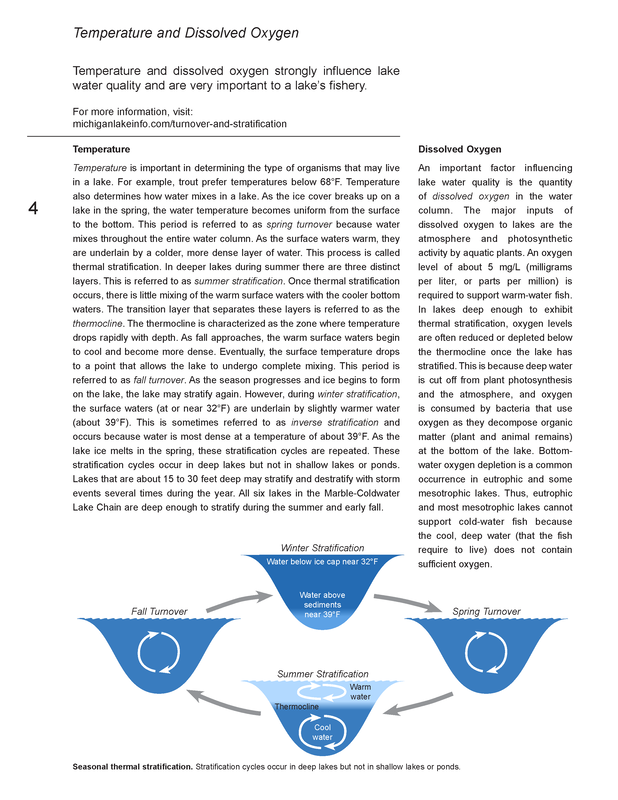
Monitoring provides advance warning of potential water quality issues, such as nuisance algae blooms caused by excess nutrients (like phosphorus and nitrogen), allowing for proactive interventions before significant damage occurs. The Water Quality Committee volunteers began monitoring Coldwater Lake’s water including Secchi disk data (turbidity) and started an Aquatic Plant Watch in August 2025. In 2026, we will add temperature (using a digital meter from surface to 88 ft depth) and dissolved oxygen data up to six times a year. In addition, we will collect water chemistry data for phosphorus and chlorophyll three to four times a year. Observations including water color, appearance and perception are also recorded as well as spring overturn (or turnover) which happens within two weeks after ice out. This allows us and the CLMP to assess the state of nutrient enrichment in the lake. The results are submitted to the CLMP who help evaluate the data and prepare annual reports for Coldwater Lake. Click here to view current and past data.
​This monitoring will augment the monitoring already implemented by Progressive Companies AE. Progressive Companies AE has been collecting water quality data for the Marble-Coldwater Chain since 2012, and they oversee the management of invasive species on the chain. Progressive Companies’ monitoring has established a baseline and reveals gradual changes in water quality, helping the Lake Association understand the lake's overall health and respond to long-term shifts. The objective data gathered from the Committee’s monitoring is essential for making informed decisions about water quality management, such as implementing eutrophication prevention strategies.

In 2027, the committee plans to implement a shoreline assessment through the CLMP "Score the Shore" program. In the meantime, property owners can assess their own shorelines by completing this on-line survey administered by the Michigan Natural Shoreline Partnership.
​
To learn more about the lake parameters the Committee will be monitoring, take a look at the fact sheets listed here. If you would like to become a monitoring volunteer, complete this online form.
Picture

​Invasive Aquatic Plants

​Weedy exotic aquatic plant species are prolific and can out-compete diverse natural vegetation, altering fish and wildlife habitat and activities.  Invasive vegetation can interfere with recreational activities such as fishing, boating, and swimming, decrease property values and negatively affect enjoyment of the natural beauty of our water resources.  You can read more about Aquatic Plant Management here.  

A combination of methods is currently used to manage invasive aquatic plant growth on the Marble-Coldwater Chain: Chemicals are being used for targeted spot treatments. Mechanical harvesting is also being implemented in larger nuisance areas. These treatments are based on expert advice by Progressive Companies AE.   This company is contracted by the Marble-Coldwater Chain Improvement Board and is being financed through a Special Assessment District.  While weed management is required to restore balance when exotic plants invade, neither chemical nor mechanical methods are perfect solutions. Chemicals kill weeds but do not remove them. As these dead plants decompose, they release nutrients (like phosphorus) back into the water. These released nutrients act as a fertilizer, promoting the growth of even more weeds and algae in the future. A mechanical harvesting approach is somewhat expensive due to the cost of the equipment and the time it takes to perform the task. While mechanical harvesting removes the biomass and prevents the decomposition of the plants in the water, some invasive plant species reproduce and spread through fragmentation as the plants are being removed. No single technique is superior; an integrated approach, using multiple methods, is often the most effective strategy.  

The committee is also looking into other methods to control aquatic plants including diver assisted suction harvesting (D.A.S.H), a non-chemical, manual method for removing invasive aquatic plants using a diver, a suction hose, and a boat-mounted pump and filtration system. Divers locate and pull the plants, feeding the entire plant, including roots, into the suction hose. This method provides a long-lasting solution by physically removing the entire plant and its root system. However, this method is extremely labor intensive and costly, which is not practical for treating the entire chain. Another newer approach to aquatic weed management is benthic barriers to kill specific weeds such as Eurasian Watermilfoil, which is found in our chain and is one of the most prolific and noxious aquatic invasive species in North America today. These barriers, made of biodegradable burlap blankets, are laid on top of the plant which inhibits its ability to photosynthesize, and kills it.  Again, this is a labor intensive and costly method. While the committee is studying these non-chemical methods which may prove more effective, current budgets established through the Special Assessment District, will not be sufficient, and cost benefit analysis needs to be conducted.
Picture
[Photo Credit - Cooperative Lakes Monitoring Program]

Prevention is the first step to eradicating exotic nuisance aquatic weeds and includes a weed watch program which has been initiated through our newly formed committee. Early detection is the key to controlling an outbreak in other areas.  Cleaning boats and equipment to avoid spreading seeds, and proper disposal of removed plant matter in upland areas is also key to controlling spread of invasive species. If you are concerned about the chemicals used to treat invasive weeds, your concerns are duly noted and we hope you will consider joining our efforts to become part of the solution.  
You can join our team here.  

​Early detection of invasive aquatic plants allows for rapid and effective management. 

In the event a suspicious plant is spotted while recreating on Coldwater Lake, this file includes a handbook of full-color photos of invasive aquatic plants and a glossary of plant terminology. Click here to view or download the handbook.

Click here for a quick reference photo guide to identifying invasive exotic aquatic plants.


If you think you have identified an exotic aquatic plant please take photos and report it here.
Report Exotic Aquatic Plants
Picture

Harmful Algae Blooms (HABs)

Harmful Algal Blooms (HABs) are large, visible growths of toxic cyanobacteria that appear as green, blue-green, red, or brown scums, resembling spilled paint or pea soup. They occur during warmer months.  High concentrations of phosphorus and nitrogen in the water fuel their rapid growth and pose health risks to people and pets.   They can cause skin irritation, gastrointestinal issues, and more severe effects.   Dogs and livestock can die within hours of drinking contaminated water.  Visual observation can’t predict HAB toxicity and suspicious blooms should be reported so testing can be administered.  You can view this picture guide  to help identify a bloom.  There are two at home tests you can perform to further help identify a bloom. 

Stay safe. Avoid areas with visible suspicious blooms and keep pets from drinking the water. If exposed, rinse off immediately with fresh water.  Be careful with fish: Eat only fillets, not organs.

If you think you have seen a  Harmful Algae Bloom, take photos and report it here. 
Report a Harmful Algae Bloom
Picture
[Photo Credit: Brent Langdon, BLPS]
Picture

What’s That Foam?

Picture
Some Coldwater Lake residents have reported an increase in foam on the lake in recent years. While foam can sometimes indicate pollutants such as PFAS , it can also occur naturally as organic matter decomposes. Higher levels of decomposing material could explain an increase in foam. For example, chemical weed treatments add to biomass decay, and more intense boating activity—especially from wake boats—can mix air with natural surfactants and stir up legacy nutrients and organic matter.

The Michigan Department of Environment, Great Lakes, and Energy (EGLE), through the DNR, periodically tests Michigan waters for PFAS, focusing on compounds such as PFOS and PFOA, which are regulated under Rule 57. The most recent report for the St. Joseph Watershed (2020) included Coldwater Lake sampling from March, May, and October 2019. While trace PFAS levels were found in the later samples, no PFOS was detected, and PFOA levels (2.6 ng/L in October 2019) were well below Michigan’s Rule 57 limit of 30 ng/L.

Although these results are reassuring, the test results are not current and continued vigilance is important. The Marble–Coldwater Chain has not had a watershed study in over 30 years, and our committee has made developing a new Watershed plan a top priority—including PFAS testing. Developing a current watershed plan will take time and resources, but it’s a critical step forward.
Picture
Natural foam is an off white, tan or brown color and does not appear dense.  If you observe foam that appears bright white, very fluffy and stiff it may contain a contaminant like PFAS.  If you suspect PFAS-related foam on the lake, please take photos and report it here.
Report Suspicious Looking Foam
Picture

Native Plants are Wildly Civilized

Spending time on Coldwater Lake is magical—whether swimming, boating, fishing, or simply listening to the waves. Lakes thrive when property owners take small steps to protect them. Traditional landscaping—large lawns, seawalls, and plant removal—often harms lakes. Instead, natural shorelines with leafy edges and aquatic plants provide food, shelter, and safe passage for wildlife. Homeowners can enjoy the beauty of both worlds. Turf grass near the house provides space for paths and play, while a shoreline border of native grasses and wildflowers filters contaminants like fertilizer and animal waste. This prevents pollutants from reaching the lake, reducing weeds and algae. By rethinking landscaping, we can protect Coldwater Lake and keep it healthy for future generations.  Get some great landscaping ideas here.  ​
Picture
[Photo Credit ​Mark Bugnaski]
Now that we have your attention, the best time to plant wildflower seeds in Michigan is either in the late fall, from mid-October through November, after the first killing frost, or in the early spring, within a month after the last frost (typically mid-April to mid-May). Fall planting is often preferred for native species as it mimics nature and gives seeds the necessary cold period to break dormancy, leading to earlier blooms. ​
Picture

​Coming Soon - Get your "Keep Coldwater Clear" Merchandise

Picture


Proudly display Flags on your lawn and Decals on your vehicles.  Don some Swag Wear with grandeur. 

​Help create awareness and let your neighbors know you support Keeping Coldwater Clear!

Check back soon to see what fun items are available. 

Picture

Get Involved

You can get involved in lake improvement activities by volunteering for water monitoring and invasive weed watch,  plus many other roles to protect water quality.
Join the Committee

Join Our Community

Become a Coldwater Lake Association Member.  Read about all of the membership benefits.  If you are already a member, Thank you for your Support.
Join the Association

Attend Our Meeting

Stay tuned for date, time and agenda for our first informational meeting coming soon via Zoom.  Once we finalize our plans come back here to RSVP.
RSVP - November 18, 2025
Follow us on Social Media
Picture
Copyright © 2025
  • Home
  • Association Info
    • Golf Cart Ordinance
    • Become a Member/Renew
    • Programming
    • Building Rental
    • Board Members
    • Marine Patrol
    • Lake History
    • Memberships/Donations
    • Contact
    • Fire Department Donors
    • Newsletter
  • LAKE EVENTS
    • Lake Events/Activities
    • Boater Safety Classes
    • Fireworks
  • Water Quality